
Medication Does Not Work or Is Not Suitable? Medical-Grade Vacuum Erection Device as a Non-Invasive ED Option
Medication Does Not Work or Is Not Suitable? Medical-Grade Vacuum Erection Device as a Non-Invasive ED Option
A medical-grade vacuum erection device (VED) is a non-invasive, non-drug option for erectile dysfunction and penile rehabilitation. It may be considered for men who cannot take oral ED medication, respond poorly to medication, or need post-operative rehabilitation after evaluation by Dr. Chao-An at Morning Urology Clinic.
After a cardiac stent, while taking nitrates — what options remain?
A common situation in clinic: a man who has had a cardiac stent and takes nitrates regularly avoids addressing erectile problems altogether, because oral PDE5 inhibitors are absolutely contraindicated with nitrates.
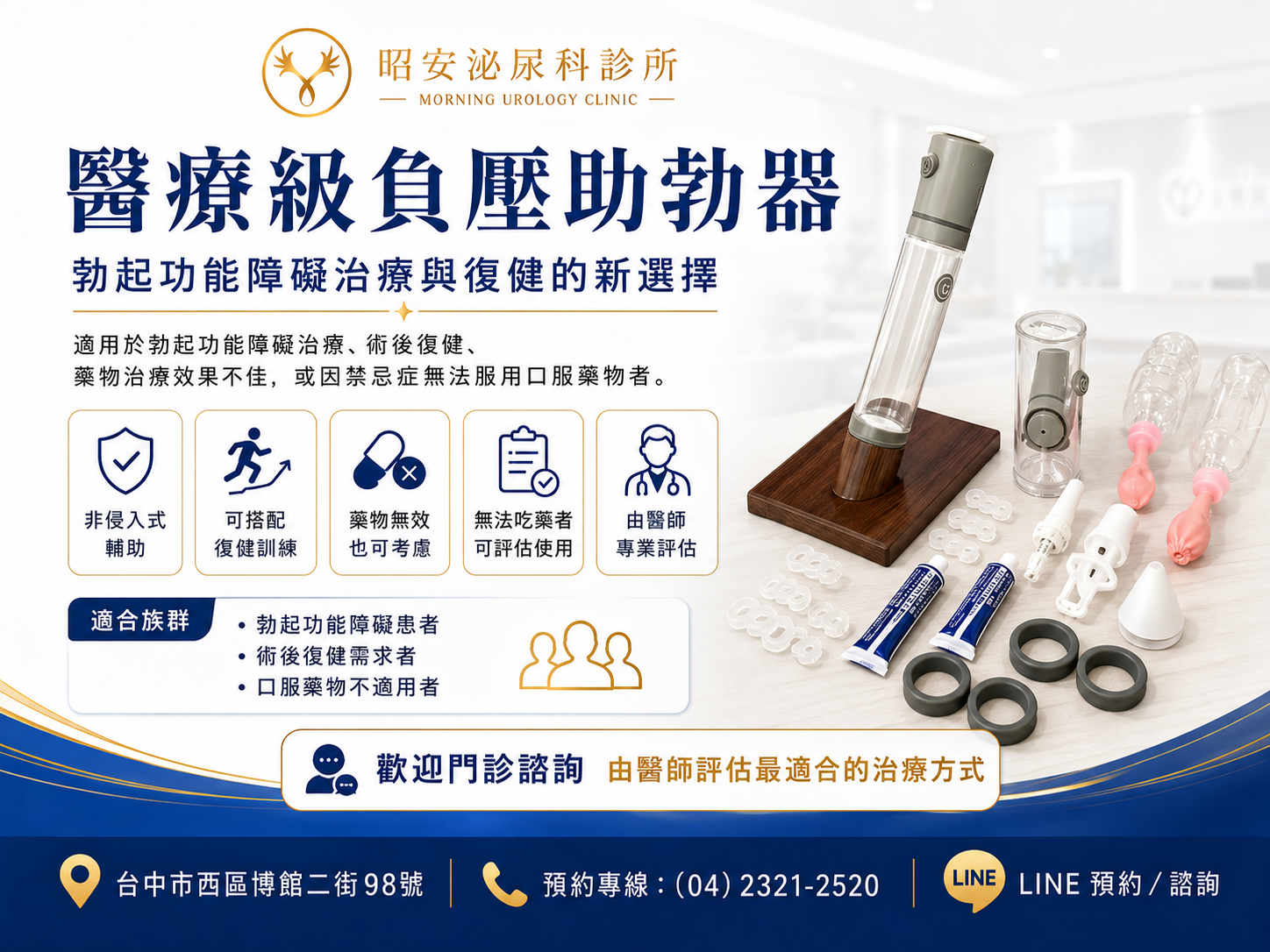
Dr. Chao-An explained that heart safety comes first, but being unable to take oral medication does not mean giving up treatment. A medical-grade VED uses negative pressure to draw blood into the corpora cavernosa and may use a constriction ring to help maintain an erection.
Important: consult a urologist before using any device
VED use involves pressure control, ring timing, skin condition and bleeding-risk assessment. Men with cardiovascular disease, anticoagulant use, easy bruising, or a history of prostate surgery should be evaluated at Morning Urology Clinic first.
How does a medical-grade VED help erectile dysfunction?
The penis is placed into a clear cylinder, and negative pressure draws blood into the erectile tissue. For intercourse, a constriction ring may be placed at the base to reduce venous outflow. VED does not rely on oral drug metabolism or injection, so it may be considered for patients who cannot use PDE5 inhibitors, have poor medication response, have nerve-related ED, or need post-prostatectomy penile rehabilitation.
ED treatment option comparison
| Item | Oral PDE5 inhibitors | Medical-grade VED |
|---|---|---|
| Mechanism | Drug-mediated vascular dilation | Physical negative pressure draws blood into erectile tissue |
| Systemic side effects | Headache, flushing, blood pressure change may occur | No systemic drug side effects |
| Cardiac medication limits | Contraindicated with nitrates | No same-type drug interaction with cardiac medication |
| Rehabilitation role | Usually single-event assistance | May support penile rehabilitation training |
Safe use: the 30-minute rule and medical-grade pressure control
- Do not keep the constriction ring on for more than 30 minutes.
- Use enough water-based lubricant to improve sealing and reduce friction.
- Avoid unregulated suction products without safety release or medical guidance.
Common questions
Can VED replace ED medication?
Not always. But for men who cannot take medication or respond poorly, it is a non-drug option worth medical evaluation.
Can it be used after prostate surgery?
Some patients may use it for penile rehabilitation, but timing and method should be confirmed by a physician.
Should it hurt?
With correct pressure, lubrication and timing, most users can adapt. Stop use and seek care if pain, bruising or numbness occurs.
Doctor’s note: ED may relate to cardiovascular disease, diabetes, nerve function or post-operative recovery. If you have reduced rigidity, medication contraindications or rehabilitation needs, visit Morning Urology Clinic for evaluation by Dr. Chao-An.
The constriction ring has a time limit; leaving it on beyond about 30 minutes can cause tissue hypoxia and bruising. If you take anticoagulants, bruise easily, or have had prostate surgery, the pressure setting and technique should be assessed by a doctor before you start.