PrEP in Taichung: How to Get It, Who Qualifies, Daily vs On-Demand
What usually holds people up is not whether to take PrEP, but three practical questions: how to obtain it, what it costs, and what goes on record.
Explained by Dr. Chao-An Chen, urologist, at 昭安泌尿科診所 (Morning Urology Clinic), West District, Taichung.
In short
- PrEP prevents HIV only. It does not prevent syphilis, gonorrhoea, chlamydia or genital warts (HPV), and it is not contraception.
- There are five ways to obtain PrEP in Taiwan. They differ in eligibility, waiting time and whether blood tests are required. All five can be assessed at this clinic in a single visit.
- The government-funded programme is limited to Taiwanese nationals and defined groups. Most foreign residents and visitors will use a self-paid route. See the eligibility section below.
- Two regimens exist: daily, and on-demand (2-1-1). On-demand has strict limits and is not suitable for everyone.
- Before starting, HIV-negative status must be confirmed. Hepatitis B carrier status and kidney function should be checked at the same time. Costs are explained at the consultation.
What PrEP is, and what it does not cover
PrEP (pre-exposure prophylaxis) means taking antiretroviral medication before any HIV exposure, so that the virus has difficulty establishing infection if it enters the body.
Taiwan CDC states that PrEP can provide over 90% protection against HIV when it is taken regularly as directed by a physician and adequate drug levels are reached; it also notes that protection is not 100%, so condoms and water-based lubricant are still needed. The US Centers for Disease Control and Prevention puts the reduction in risk of getting HIV from sex at about 99% when PrEP is taken as prescribed. The two figures come from different sources and are measured differently, but they agree on the decisive factor: adherence. Missed doses lower the drug concentration in the body, and protection falls with it.
PrEP protects against HIV and nothing else. Syphilis, gonorrhoea, chlamydia and HPV need separate measures — condoms, regular screening, and vaccination where available. If you are starting PrEP, this is the right moment to arrange baseline screening for the other infections as well.
If you are not a Taiwanese national: read this first
Taiwan CDC runs a government-funded PrEP programme. Its stated groups are:
- Spouses or sexual partners of people living with HIV who test HIV-negative (women given priority);
- Taiwanese nationals aged 35 or under who test HIV-negative;
- People using substances during sex who have joined a drug-treatment programme, and sex workers — these two groups are not subject to the age limit.
In practice this means that if you are a foreign national, the government-funded route is generally not open to you, and you would use a self-paid route instead. Eligibility and the number of places are revised each year by the competent authority; the official announcement takes precedence over this page.
Two further points that apply to everyone: places are released each January and fill quickly, so most applicants are on a waiting list; and being eligible is not the same as having a place. There is no protection while you wait. If you need protection now, start on a self-paid route and switch later if a place opens.
Five ways to obtain PrEP
| Route | Who it suits | Blood test | When you receive it |
|---|---|---|---|
| Self-paid purchase | You want to start now and not wait for a place | HIV-negative status must be confirmed | Same visit |
| Manufacturer support programme | You expect to take it regularly over a longer period | Blood test required | Same visit; roughly three months’ supply per collection |
| Taiwan CDC government-funded programme | You meet the criteria above and can attend every three months | Blood test every three months | Depends on available places |
| Personal import for own use | You can accept shipping time | Blood test required | The clinic issues the medical certificate and prescription at the visit; delivery follows the platform’s own schedule |
| Long-acting injection | Taking a daily tablet is difficult, or you would rather not keep medication at home | HIV-negative status confirmed before every injection | By appointment |
Costs are explained during the consultation and follow the self-pay schedule filed with the Taichung City Government Department of Health. This page does not list prices.
The five routes do not differ in how the medication works. They differ in eligibility, waiting time, whether blood tests are needed, and whether there is a fallback if the route you had in mind turns out not to be open. Assessing them in one visit — kidney function, hepatitis B status, your pattern of exposure and whether you can attend follow-up — usually narrows it to one or two sensible options.
Two regimens: daily, and on-demand (2-1-1)
Daily
One tablet at a fixed time each day. Suitable for everyone, and the only regimen suitable for vaginal exposure. It takes a period of continuous dosing before tissue drug concentrations are high enough.
On-demand (2-1-1)
Two tablets 2–24 hours before sex, then one tablet every 24 hours for two more days.
2-1-1 has clear limits. It is not for everyone:
- Only for anal exposure in cisgender men. Not for vaginal exposure.
- Only with TDF/FTC. FTC/TAF must not be used for 2-1-1 — there is currently no evidence supporting it.
- Not advised for hepatitis B carriers. Stopping and restarting can trigger an acute hepatitis flare.
The exact schedule is worked out at the consultation, based on your actual pattern of sexual activity.
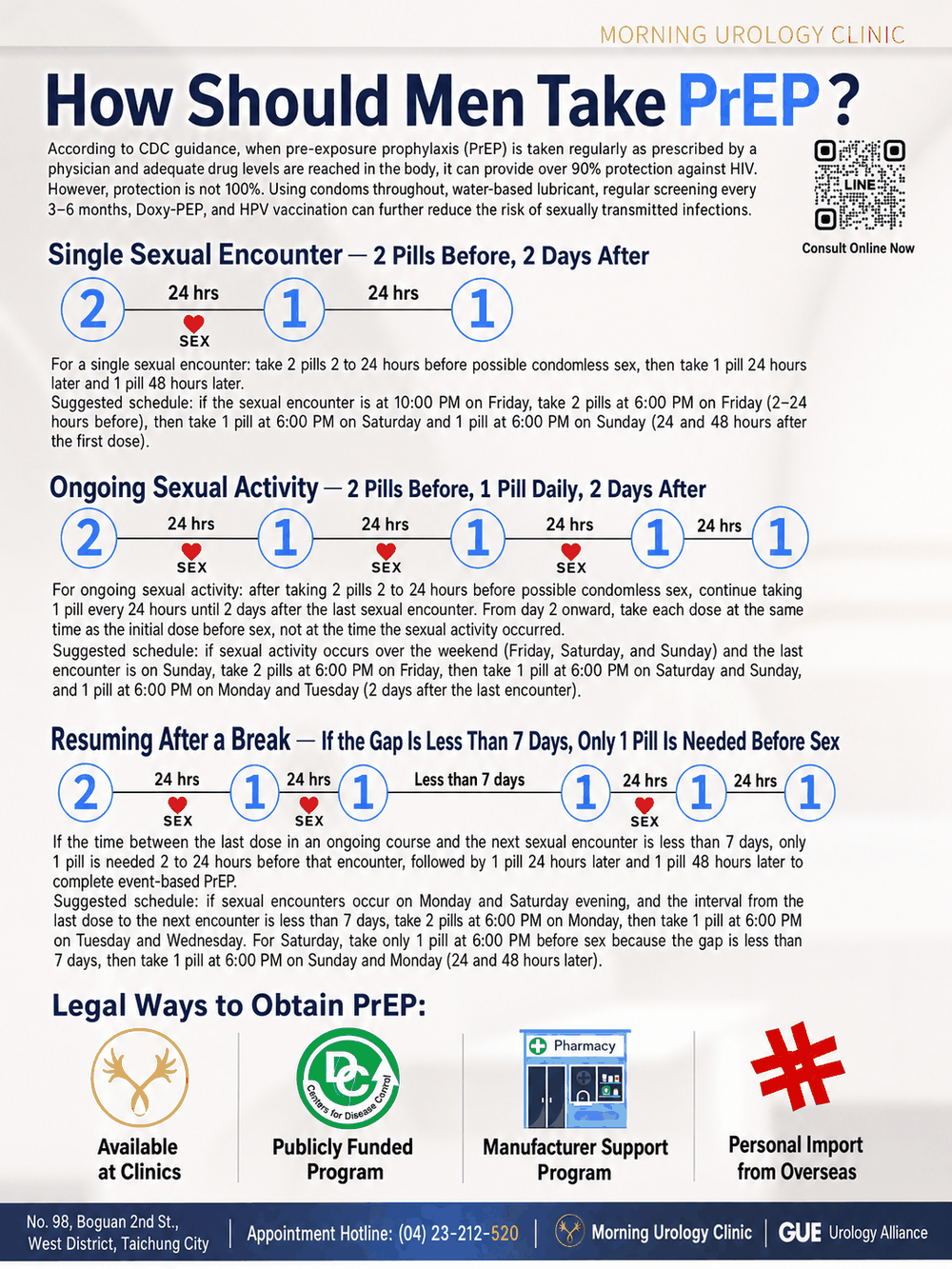
From day two onwards, the dosing time follows the time of the first dose, not the time sex occurred. This diagram is for understanding the timing only. If any of the three limits above applies to you, on-demand dosing is not suitable; the final plan is decided at the consultation.
Before you start: four things to confirm
- HIV-negative status — the most important one. Starting PrEP during acute infection can select for drug resistance and narrow later treatment options.
- Hepatitis B carrier status (HBsAg) — TDF suppresses hepatitis B virus. A carrier who stops the medication without advice can have a hepatitis flare.
- Kidney function — TDF requires a baseline value and follow-up.
- Screening for other sexually transmitted infections — syphilis, gonorrhoea, chlamydia and others.
About routes that need “no blood test”: the self-paid route can proceed once HIV-negative status is confirmed by a rapid test, which is a lower threshold. But that leaves hepatitis B status and kidney function unverified. If you have never had those two checked, they will still be recommended — not as extra testing, but to avoid the two risks described above.
If kidney function declines while you are on PrEP
The commonest issue at follow-up for long-term TDF/FTC users is a gradual fall in estimated glomerular filtration rate. Per the product information for FTC/TDF, use for PrEP is not recommended when creatinine clearance falls below 60 mL/min, so values approaching that line call for reassessment.
One clinical alternative is switching to FTC/TAF, whose intracellular conversion results in lower systemic kidney and bone exposure; its lower limit for PrEP use is creatinine clearance 30 mL/min. But FTC/TAF has two clear limits, and “newer” does not mean “better for everyone”:
- Its PrEP indication does not cover people at risk through vaginal sex — not because it was shown ineffective, but because effectiveness in that group has not been evaluated. For vaginal exposure, daily TDF/FTC remains the only oral option with supporting evidence.
- It cannot be used for on-demand 2-1-1. Anyone relying on 2-1-1 for occasional needs would have to move to daily dosing at the same time.
A falling value is a reason to look for the cause first, not to stop the medication on your own. Dehydration, infection, other medicines and even the circumstances on the day of the blood draw can all cause fluctuation, so a repeat test comes before any decision. Bring your most recent kidney function report to the consultation.
The long-acting injection
Long-acting injectable cabotegravir is given by intramuscular injection, with maintenance doses every two months; the initial injections are spaced more closely, and the full schedule is explained at assessment. It suits people who find daily dosing hard to maintain, or who would rather not store medication at home.
HIV-negative status must be confirmed before every injection. This step cannot be skipped: continuing injections while infected can select for resistance.
Twice-yearly lenacapavir for PrEP has not been approved in Taiwan as of the update date of this page.
Your visit: what to bring, what happens
- Book through the online form, LINE, or by telephone.
- Registration. Please bring your passport or resident certificate — it is needed to create the medical record. If you are not enrolled in Taiwan’s National Health Insurance, the consultation and tests are self-paid.
- Consultation. Kidney function, hepatitis B status, pattern of exposure and your ability to attend follow-up are reviewed together, which usually narrows the five routes to one or two.
- Tests and follow-up. HIV-negative confirmation and kidney function can both be arranged the same day. Follow-up intervals depend on the route you take.
Useful to bring: any previous HIV, hepatitis B or kidney function reports; a note of your current medications and allergies; and, if you are already taking PrEP, the packaging or a photograph of it.
Frequently asked questions
I am a foreign resident. Can I get PrEP here?
Yes, through the self-paid routes. The government-funded programme is limited to the groups listed above, which for the age-based category means Taiwanese nationals. Bring your passport or resident certificate for the medical record.
I already take PrEP abroad. Can I continue here?
Bring what you are currently taking and your most recent test results. Which route fits depends on the formulation you are on, when you were last tested, and whether you are on daily or on-demand dosing. That is decided at the consultation.
Will this appear in my medical records?
The self-paid routes and personal import do not go through National Health Insurance. If records are a particular concern for you, say so at the visit and the arrangements will be made accordingly. Note that a medical record itself is required by law for any consultation.
Can I use on-demand 2-1-1?
Only if all three limits are cleared: anal exposure in cisgender men, TDF/FTC as the formulation, and no hepatitis B carrier status. If the timing is hard to predict, daily dosing is the more reliable choice, and it is the only regimen suitable for vaginal exposure.
Does PrEP replace condoms?
No. PrEP acts on HIV only. Condoms, regular screening and vaccination remain the measures for the other sexually transmitted infections, and PrEP is not contraception.
Does PrEP have side effects?
The common ones are gastrointestinal upset and headache in the early period after starting it, and in most people these settle within one to two weeks. Long-term use requires follow-up of kidney function; in a small number of people taking TDF there is a slight change in bone mineral density. If kidney function is a consideration for you, alternatives such as FTC/TAF can be discussed with the doctor.
Related pages
Appointments and access
Consultations are conducted in Mandarin, and can also be conducted in English.
昭安泌尿科診所 (Morning Urology Clinic)
No. 98, Boguan 2nd St., West District, Taichung City 403, Taiwan(403 臺中市西區博館二街98號)
Consulting hours: Monday to Saturday (closed Sunday). Online booking is open 24 hours.
This page was produced by 昭安泌尿科診所 (Morning Urology Clinic). Medical content last updated: August 2026 (same as the Traditional Chinese version). English version published: 4 September 2026. Medically reviewed by Dr. Chao-An Chen, urologist.
Sources: Taiwan CDC, Pre-exposure prophylaxis (PrEP) / US CDC, PrEP for the prevention of HIV / Taiwan FDA approved product information database. Indications, contraindications and dosing follow the Chinese-language product information approved by the Ministry of Health and Welfare.
This page provides general medical information and does not replace an individual diagnosis or treatment plan. Please confirm anything concerning your own symptoms or test results at a face-to-face consultation.