

No-Hospital-Stay Prostate Treatment: Rezūm™ Minimally Invasive Water Vapor Therapy for BPH
No-Hospital-Stay Prostate Treatment: Rezūm™ Minimally Invasive Water Vapor Therapy for BPH
"Rezūm™ is a minimally invasive treatment for Benign Prostatic Hyperplasia (BPH)."
Important Note: BPH Treatment Requires Proper Medical Evaluation
Rezūm™ water vapor therapy may be an option for BPH, but suitability depends on prostate size, obstruction pattern, medical history, medication use, and urinary test results. Please consult Dr. Chao-An at Morning Urology Clinic for individualized evaluation.
A Senior Patient Who Lived With Urinary Symptoms Because He Was Worried About Major Surgery
A man in his seventies came to the clinic with his family. Frequent urination, nocturia, and incomplete emptying had already affected his quality of life.
After reviewing ultrasound findings and his general health, Dr. Chao-An explained that treating BPH does not have to mean a hospital stay. Rezūm™ uses water vapor energy to shrink enlarged prostate tissue in a minimally invasive manner. At Morning Urology Clinic this treatment is always done under sedation-type general anesthesia given through a vein (IVGA), and an anesthesiologist checks heart and lung condition before the treatment and monitors the patient during it. The treatment itself takes about 10 to 20 minutes, and most people go home the same day after a period of observation, usually with a urinary catheter in place for about one to two weeks.
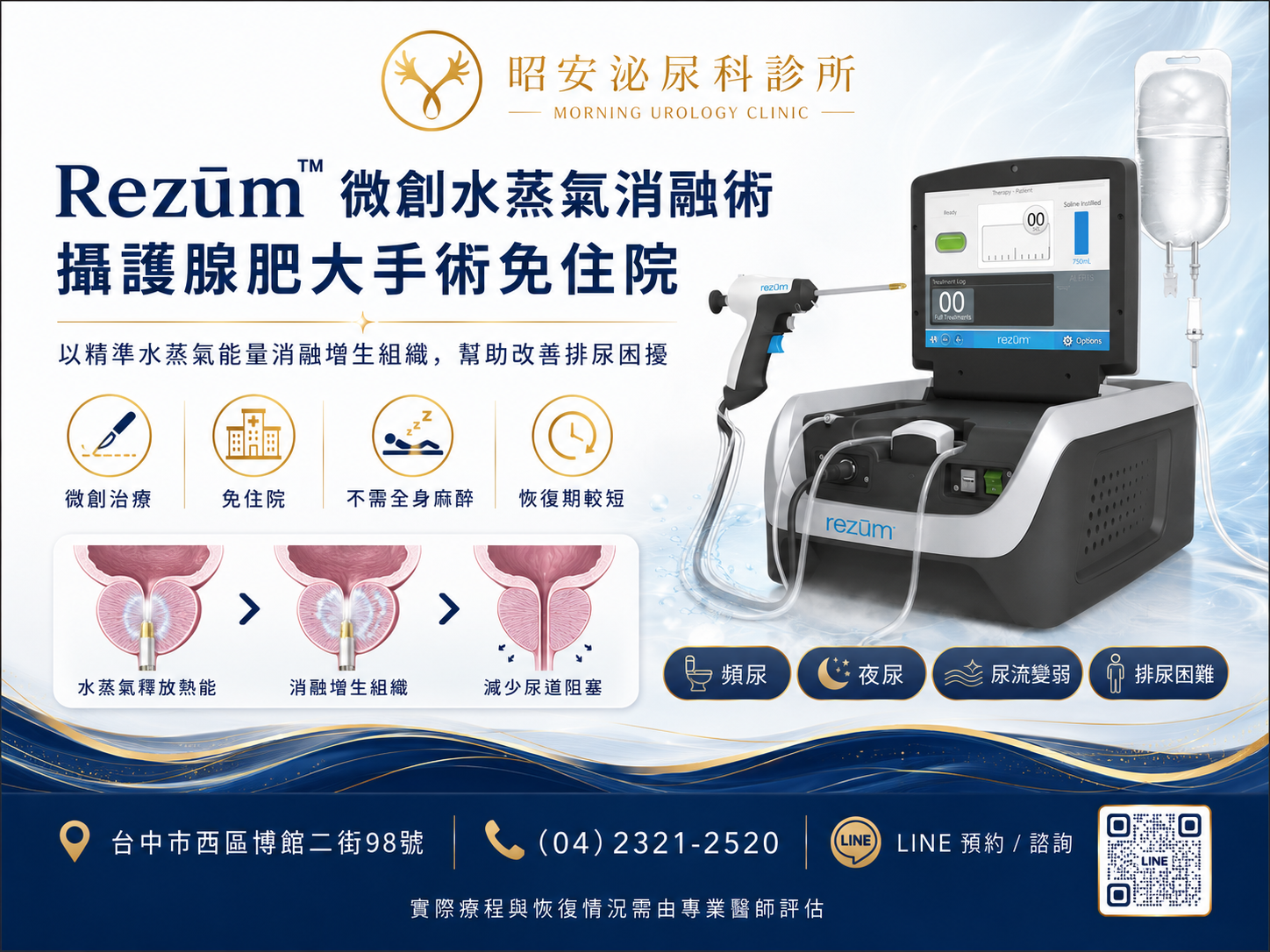
What Is Rezūm™ Water Vapor Therapy?
Benign Prostatic Hyperplasia (BPH) can lead to frequent urination, nocturia, weak urine flow, and incomplete bladder emptying. For elderly patients or those with chronic illnesses, traditional surgery usually means a hospital stay, which many patients and their families worry about.
Rezūm™ delivers sterile water vapor precisely into enlarged prostate tissue. Thermal energy helps the tissue gradually shrink and be absorbed by the body, reducing urethral obstruction.
Three Stages of Gentle Relief
1. Water vapor releases thermal energy ➔ 2. Enlarged tissue is ablated ➔ 3. Urethral obstruction is reduced. Improvement is usually gradual because tissue shrinkage takes time.
Safety, Side Effects, and Recovery
- Indications: BPH-related urinary frequency, nocturia, weak stream, and incomplete emptying.
- Possible recovery symptoms: Temporary urinary discomfort, increased frequency and a small amount of blood in the urine may occur. A urinary catheter is routine after this treatment; at this clinic it usually stays in for about 1 to 2 weeks.
- Time to improvement: Improvement is usually gradual, often from 2 weeks to 3 months after treatment.
UroLift® or Rezūm™: How to Choose?
Rezūm™ may be considered when median lobe enlargement contributes to obstruction. UroLift® may be preferred when very short recovery and sexual function preservation are major priorities.
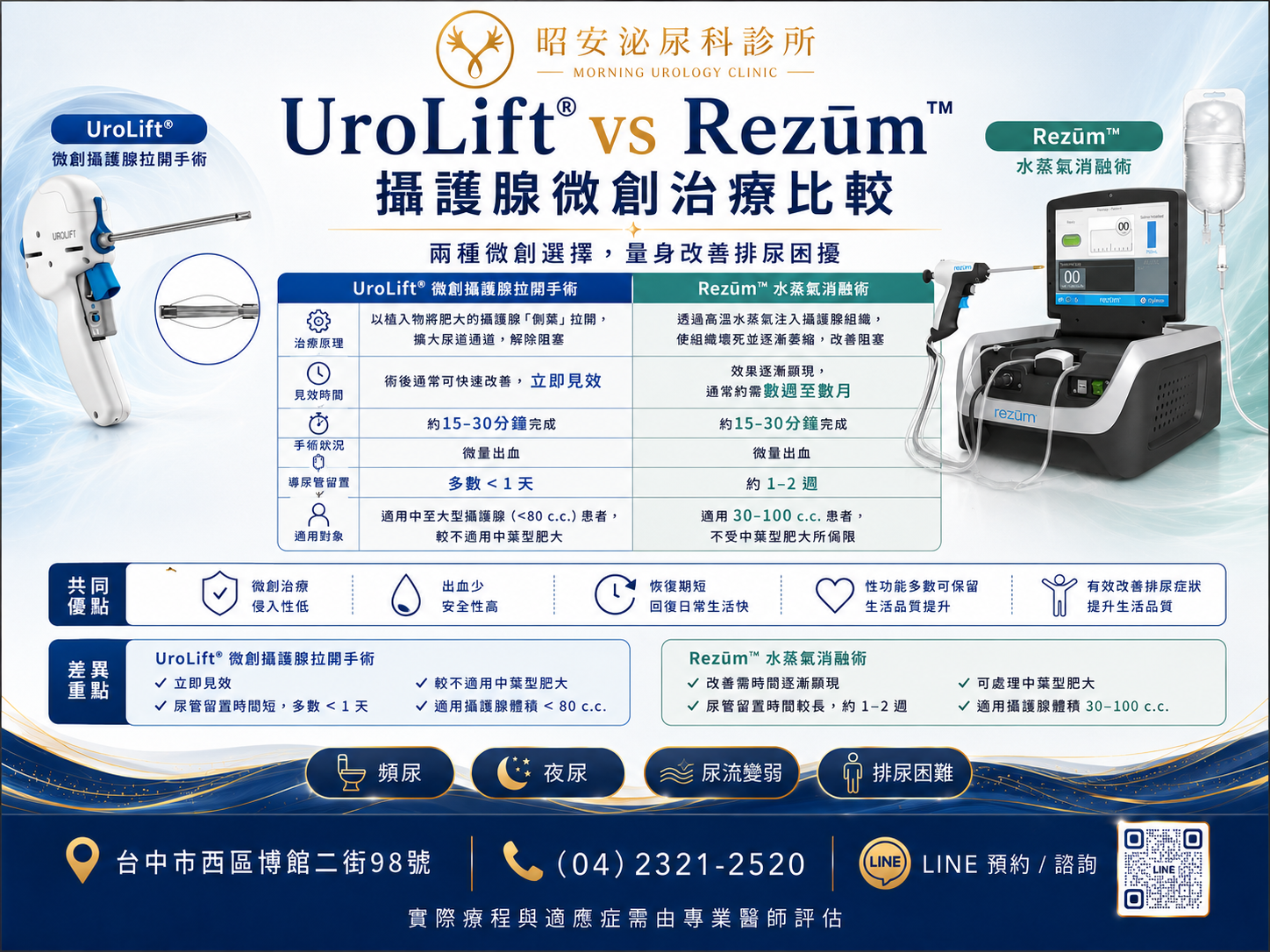
Who May Be Suitable for Rezūm™?
Rezūm™ is a minimally invasive option for BPH. Suitability should always be determined by a urologist.
- Patients with moderate prostate enlargement, often around 30 ml to 80 ml.
- Patients who respond poorly to medication or experience medication side effects.
- Older patients who want to avoid a hospital stay, and who are found suitable for intravenous general anesthesia (IVGA) at the pre-treatment check.
- Patients who value urinary comfort, quality of life, and sexual function preservation.
Doctor’s Note: Urinary Symptoms Are Not Just Aging
Frequent urination, nocturia, weak stream, and incomplete emptying may be related to BPH, but they may also involve bladder function, infection, medication, or other diseases. A urologic evaluation is recommended before deciding on Rezūm™ or other treatments.
Key points before treatment
Does Rezūm™ require hospitalization?
In many cases, it is performed as a minimally invasive outpatient treatment. Final arrangements depend on medical evaluation.
Is Rezūm™ suitable for all BPH patients?
Not always. Prostate size, obstruction location, median lobe enlargement, symptom severity, and medical conditions must be evaluated.
When can urinary symptoms improve?
Improvement is gradual and may appear between 2 weeks and 3 months after treatment.
Which department should I visit for BPH?
A urology clinic can evaluate urinary flow, ultrasound findings, residual urine, and prostate condition.
Water vapour ablation works gradually. In the first week or two urinary frequency and flow can temporarily get worse, and clear improvement usually takes two weeks to three months. Medication continues as directed during this period, and a urinary catheter is routine, usually for about 1 to 2 weeks at this clinic.